Cul-de-sac of the Mind:
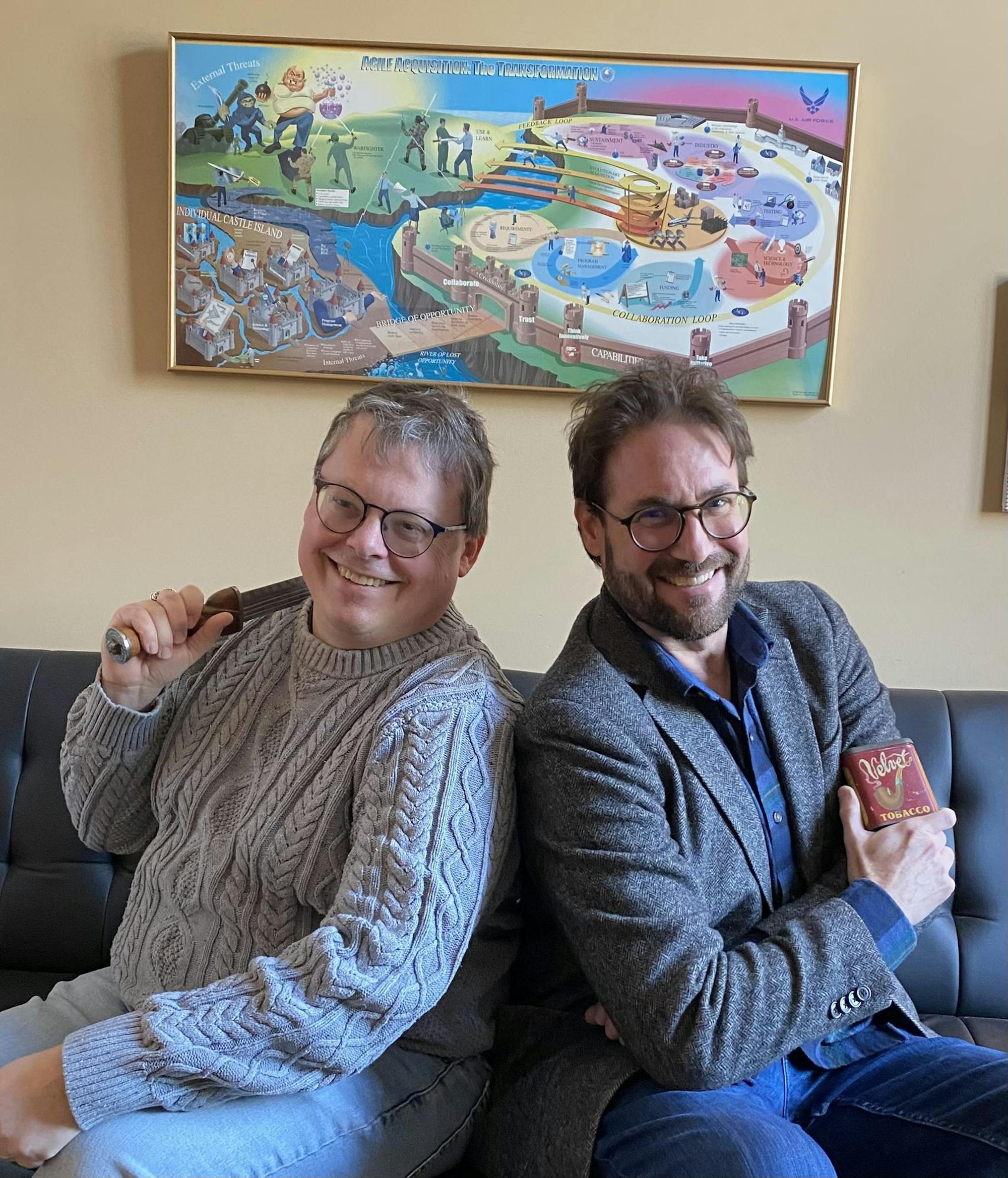
Profs. Raffensperger and Jackson illustrate that starting with the same premise seldom results in deriving a similar conclusion.
From Metal to Grunge
Prof. Chris Raffensperger
Professor of History and Chair of the Department
Kenneth E. Wray Chair in the Humanities
Director, Ermarth Institute for the Public Humanities
Medieval Europe, Russia, Ukraine
The downside of letting Dr. Jackson choose our topics is that sometimes the small age difference (he’s older) matters a lot. While I did listen to such metal “classics” as "Pour Some Sugar on Me" by Def Leppard and "School’s Out for Summer" by Twisted Sister, it wasn’t really my kind of music.
When Nirvana appeared on the scene with their album “Nevermind,” I noticed, and I saw the attraction. The music was so much more interesting, less angry, less over the top. It spoke to a generation that was tired of the anger and lust (witness Mötley Crüe’s "Cherry Pie") of the 80s rock genre. Instead, the 90s grunge movement was tired and checked out. For visual guides see the randomness of Richard Linklater’s "Slacker" or Kevin Smith’s "Clerks." The latter, in particular, is the epitome of the checked out grunge ethos. The characters wear flannel, no matter the weather. They hate their jobs, and they rarely do them; instead preferring to hang out with one another and talk about inanities. The “counter-culture” shift of the 90s (as it is often called) is one in which authority doesn’t matter-not because we’re fighting it-but because we just don’t care. Apathy reigns.
Meanwhile, across town, what I was listening to at this same time was the evolution of rap into hip hop. Starting with NWA (look it up, don’t ask what it stands for), Ice-T, and the Beastie Boys, the music was lyrical and had a great beat, as well as being thought-provoking and catchy. If you know Ice-T only from his work on "Law and Order," you should check out his song "Cop Killer" to see the breadth of his work and why it is startling to those of a certain age that he is on Wheaties boxes.
Those well produced, but often raw, lyrics, were shifting into the 90s in ways that made rap music more popular, and deeply related to its popularity among white audiences, more melodic. The Bad Boy empire was a huge part of that shift, led by Sean Combs (alias Puff Daddy, P. Diddy, Diddy, and Prisoner #674985). Taking straight from the streets talent like Biggie Smalls and adding high production values and, especially, samples from older music, the hip hop genre took off in popularity. The 1998 movie "Godzilla" featured a Puff Daddy song "Come with Me," which uses bits from orchestral music and a Led Zeppelin sample performed by Jimmy Page himself (the founder of Led Zeppelin). The song became Derek Jeter’s walk out song for the New York Yankees, helping to embed it, and hip hop in popular culture.
What does all of this mean? Music shapes our ideas about who we are and about society as a whole. A key part of the past, even the recent past, which is going missing today, is the shared relevance of musical trends. Across America in the 1980s and 1990s, teens listened to largely the same music. Thus, they heard the same things, and in many ways, thought the same ideas. That shared cultural relevance, and reference, is lost today.
Prof. Ross Jackson
Associate Professor of Business & Economics
Program Director, Master of Science in Analytics
Management
Calendars orient as well as distort. As a simple index of chronology, the 1980’s occurred between the dates of January 1, 1980 and December 31, 1989. However, as a cultural epoch, one might argue that the 1980’s, or what we have come to understand as “the 80’s,” really occurred between the dates of January 20, 1981, with the inauguration of President Reagan, and the election of President Clinton on November 3, 1992. Time can be elastic. Exploring these Reagan/Bush years from a sonic perspective reveals something as to how shifts in culture are experienced.
Disco and Punk were largely ending by the close of the Carter administration. Politics often conflates with taste. Along with the beginning of the Reagan administration, heavy metal and “glam rock,” were gaining increased cultural prominence. Bands included under that banner could include Metallica, Iron Maiden, Def Leppard, Guns N’ Roses, Megadeath, Quiet Riot, Twisted Sister, and Mötley Crüe. Loud amps, big hair, and pyrotechnics were all the rage. Until they weren’t. It is a short road from popular to passe.
Somewhere in the middle of 1991, with the release of albums like The Smashing Pumpkins’ “Gish,” Pearl Jam’s “Ten,” and Nirvana’s “Nevermind,” a seismic shift occurred within the United States. Grunge had arrived. It is perhaps only coincidental that around that same time America searched once again for something different politically, bringing the Reagan/Bush years to a close.
There is no accounting for taste. People like what they like. There isn’t much more to say about that. What is interesting isn’t what people liked, but how they responded to change. Some people, who were committed to the metal scene, rejected grunge as a betrayal of all that metal had represented, which seemed to be some form of aggressive hedonism and/or misanthropic destructiveness. Others welcomed grunge as an anti-establishment and anti-consumerist movement. Along these battlelines friendships were strained, if not ended. Polarities are like that, even ones based on aesthetics. If one moves forward, it is hard for the person remaining stationary to not feel left behind.
The metal/grunge polarity is a grid along which one can explain certain aspects of the 80’s to early 90’s. However, there is plenty omitted along that axis. Perhaps most relevantly for us here and now, that duality ignores college radio. Bands like R.E.M., The Smiths, Pixies, The Cure, Teenage Fanclub, and Toad the Wet Sprocket gained cultural prominence and then a degree of commercial success largely due to student-run programming from underground, university radio stations. In sound, content, and format, college radio was truly alternative. Where popular culture forces an endless battle between “Coke” and “Pepsi,” college radio provides us with “Orange Crush.” Because it largely operates outside corporate interest and is youth-directed and managed, college radio, like a student paper, provides society with a different, and beneficial, perspective. Poets and revolutionaries welcome this. A great adjunct to a strong student newspaper, like The Torch, is a vibrant college radio station. Alienated suburbanites would benefit from hearing your voices and music selections. Bring back The Berg! It might not be on the calendar yet, but it’s time.