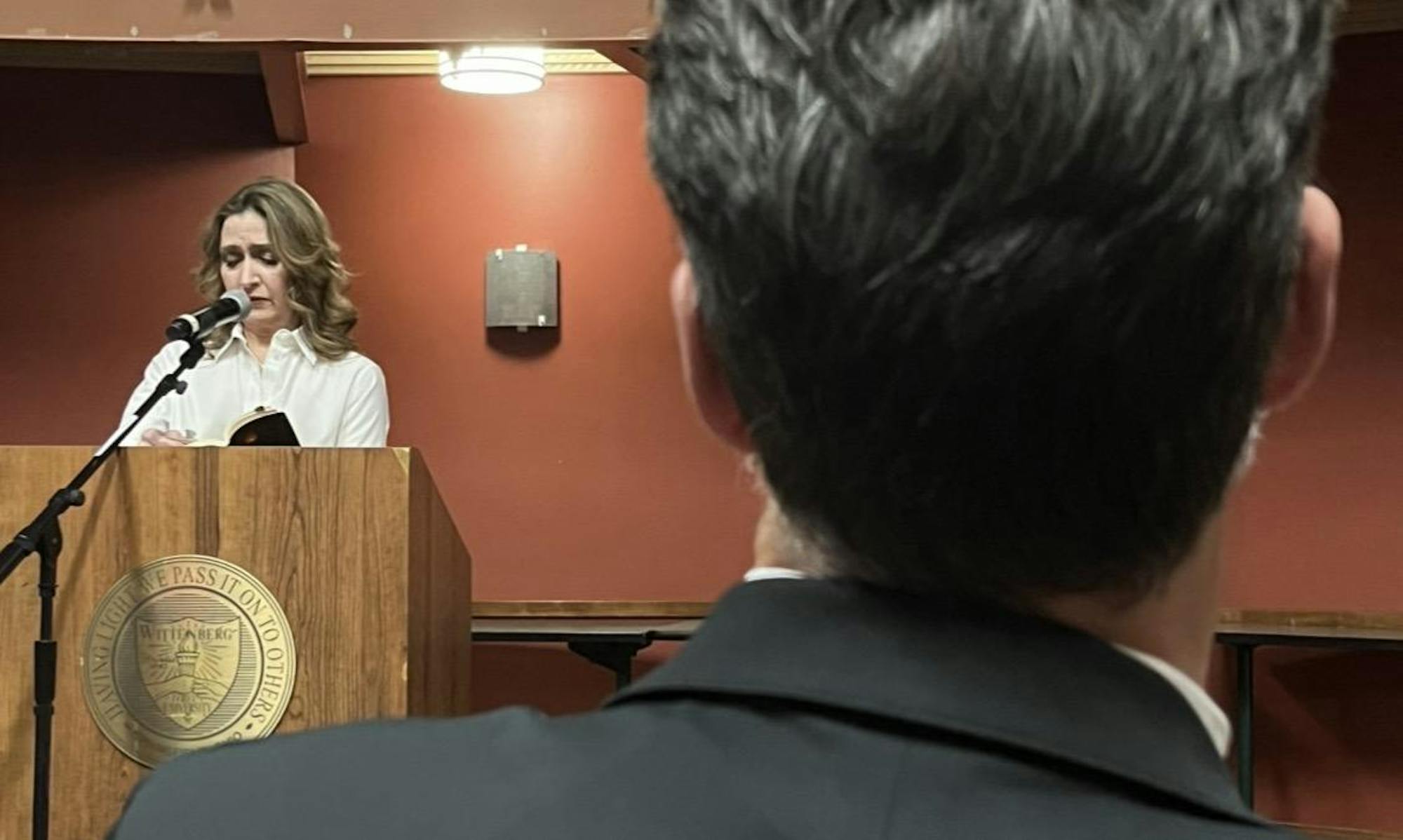
Elizabeth Brady—the wife of Wittenberg’s current President, Christian Brady, and an associate teaching professor for Penn State—read last Thursday, March 19, from her 2024 book of essays, “Oil for Your Lantern: Sharing Light After the Death of a Child,” sharing her journey of grief with attending students, faculty, and community members.
The event was introduced by Wittenberg English professor Marjory Wentworth, who painted Brady as an accomplished figure who was not defined by, but built herself around, the grief of losing her son, Mack. She praised Brady’s four-inch-by-six-inch “precious” book and the “honest and heartfelt” wisdom contained within, encouraging the audience to procure their own small books to carry with them.
Then Brady took the stand, briefly talking about the purposeful small size of the book, before beginning to read five essays for the audience, two from the first two sections and one from the third.
The first essay, “The Downstairs Thief,” compares the loss of Mack to a thief who stole items downstairs but did not go upstairs, into the more personal and sacred area of the house. She emphasized that losing him did not take away the memories of love she had with him—“moments of care, bath, bedtime stories, prayers, [and] nights of sickness,” among other precious times, she recalls.
Brady’s second essay, “Sit Still and Uncover Your Eyes,” centers around “facing death and choosing life, sometimes several times a day,” she said. She directly talked about the scene of Mack’s death, the painful grief that takes time to process, and the subsiding fear of confronting it. Both Elizabeth and Christian Brady, who was attending his wife’s reading, were tearful during this essay in particular.
Brady then turned to a more uplifting tone and read “About Your Room,” which was about her small journey rediscovering Mack’s room after having left it untouched for years. Written like a letter to her son, she dove into the details of the room that made it his and the happy memories they contained, like a robe with bear ears. “You were so cool in it,” she told him, and us.
“Merry Go Round and Round” featuring the carousel in the Washington D.C. National Mall, is transformed into a metaphor about letting time pass. She says, “I don’t hesitate to give myself permission to hop off and buy some warm popcorn to munch while I sit on a bench to rest in the shade.”
Brady closed off with a reading from “‘God, Help Me Do What is Mine to Do.’” This essay reflects on her journey and advises the reader—and audience—how to survive grief by continuing to live and love. “Life will never be the same,” she said, “but it can be good.” There is work and pain in it, but life has too much good to let it weigh on us forever.
The event ended with a Q&A with audience members.