


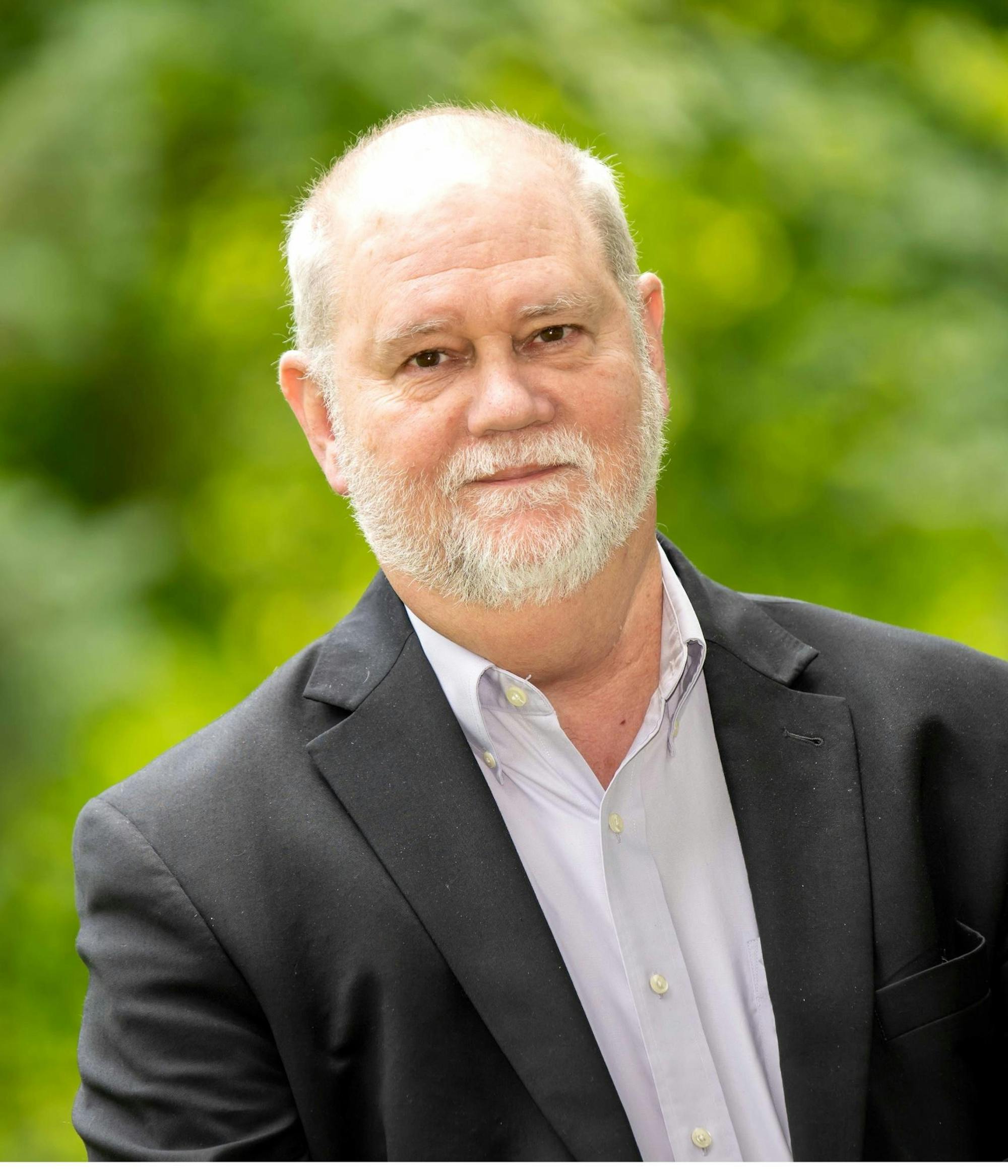
As a young boy growing up in North Carolina, Thomas Taylor read the World Book Encyclopedia, tracing over the signatures of the presidents and studying newspaper articles such as the devastating Burning of Columbia in 1865. He knew that history would be his passion well into adulthood.
Now a history professor of 38 years at Wittenberg University, Taylor has not only realized his destiny, but also seen its lessons played out during his tenure at the university. Today, Taylor, 71, cuts a familiar figure on campus. He's known for his salty white beard and mischievous, piercing brown eyes. In other words, he's an instituion. As a college student, however, he initially didn’t think becoming a history professor was his calling.
Taylor had planned on being a music major, but when he realized he wouldn't be studying mathematics (a passion of his), he decided to focus on history instead, he said. What's more, he didn't think he had what it took to become a professional musician. And being a high school music teacher sounding boring.
Just because Taylor decided not to pursue a music education in college, that doesn’t mean he doesn’t play music at all now. He started the Wittenberg Faculty Rock Ensemble & Entourage in the summer of 2004, where he envisioned a revolving cast of musicians on campus playing in the ensemble. (Ultimately, eight people joined.) The group has since downsized to a handful of mostly retired professors. When they play, it's usually ‘60s and ‘70s classic rock and pop music, such as songs by The Beatles and The Clash.
“Music history is such a specialty,” Taylor said with energy. “Music is always coming out of the culture, and then it’s feeding back into the culture.” He previously taught History of Rock and Roll courses at Wittenberg and uses music to teach about U.S. history. Ask him about historical songs during World War II or the Vietnam War and he’ll rattle off the songs that left a cultural impact.
“I can’t teach you that period without thinking about what’s going on in music,” he said with a chuckle.
Taylor went into graduate school at the University of Illinois when there were no full-time tenure jobs for him at the time, landing an assistantship instead. Starting graduate courses in history was the moment he realized that history was his true destiny. “I was hooked,” he said, reflecting on his admiration for his fellow graduate students as they discussed different interpretations of several readings. He eventually got his Ph.D. from the University of Illinois in American Intellectual/Culture History.
Taylor almost didn’t follow through with history after college, because he was torn between graduate school and law school. “I still don’t know if I did the right thing,” he said softly with a conflicted look. But Taylor’s lively experience with his intellectual peers made history fun and exciting for him, setting him up for his eventual role as a college professor.
Taylor has done a lot of work as a local historian for Springfield and for Wittenberg. It all started when former Wittenberg president William Kinnison (1974-1995) involved him in the Clark County Historical Society, which led to Taylor getting involved in the broader Springfield community. He conducted a number of local research projects and publications, which allowed him to meet several entertaining individuals, forging connections that would last a lifetime. One of these connections includes Tom Stafford, a former Springfield-News-Sun reporter who served briefly as an advisor to the Wittenberg Torch. Taylor calls Stafford "the nicest person in Springfield."
“Anytime I’m out somewhere with him or we see each other, there’s all these people who know who he is,” Taylor said with a smile. “I don’t mean big splash local celebrity, but there’s always somebody who knows who he is.” Stafford sings and plays drums with the Wittenberg Faculty Rock Ensemble & Entourage; Taylor said the former journalist is “darn good.”
One of Taylor’s historical projects was conducting research on Wittenberg’s Weaver Chapel for its 50th anniversary in 2006. While diving into his work, Taylor’s perspective of Wittenberg changed.
“When you study the whole history of it, you realize there’s a lot more to that story than you thought,” he reflected. “I remember saying to a lot of people, if you’re going to be a great institution, you have to take your history seriously,” he said, underscoring his point with a soft knock on the table. When he researched how the university developed over time, it gave him a richer sense of its core values and what themes popped up over time, such as its mission, calling, and role as a liberal arts institution.
He said he has a better appreciation for how people have perceived the institution over its long history, noting that Wittenberg has gone through some very rough times, such as scary fiscal challenges, dramatic restructuring, and reconfiguring academic departments and majors.

The United States has also been through a lot of struggles in its 250 years as a nation and the past decade is no different. Public debates over federal power, regulation and trust have left many Americans questioning the future of the country. But isn't this something that the United States has already been through?
“A thousand times yes,” Taylor exclaimed. He emphasized that he sees the hardships that past generations encountered in the United States in the modern-day turmoil, connecting generational trauma. His parents went through the Great Depression and the horrors of World War II, while today's generation has experienced the terrorist attacks of 9/11 and the COVID-19 pandemic.
“If I don’t understand what those generations went through,” Taylor mused, “then there is a whole lot about the modern world I do not understand.”
People today greatly misunderstand United States history, Taylor said, citing, for example, the belief that the nation is a full democracy, when in reality it was founded as a republic. He commented that while it was true that the United States did adopt democratic values over time, forgetting that America was initially a republic, well, that has consequences. That misunderstanding comes with less education on federal policy as well.
“It scares me,” Taylor mumbled, with a worried look on his face. “It’s more than troublesome.”
He went into detail about how the United States is a massive economic and militaristic power, and with that comes massive responsibility over the world, whether its citizens want that responsibility or not.
“Nobody cares if you don’t want it, because it’s an empire of influence and you can’t escape that, you can’t escape that responsibility.”
One of the best ways to understand the historical past such as the founding of the United States is to be grounded in the past. That goes for people’s personal lives as well.
Something most people wouldn’t know about Taylor is that he was adopted and didn’t meet his biological family until he was in his 40s. Being from South Carolina and the Midwest, he learned a lot about the history of his family tree via family members. Through it, he gained insights about himself.
“I actually understood me a lot better after that,” he admitted. “I was enough different in my own family different from them.” There were things about his birth family that really resonated with him, such as his grandfather facing a similar dilemma about going into academics or to law school, where his adoptive grandfather went the opposite way, going into law. Also, he didn’t grow up in a family of musicians, but there were several musicians in his birth family, as well as ballroom dancers. But the desire to move gracefully came naturally.
“I remember taking ballroom dancing lessons,” he said. “But I was slow-footed, so I never danced much.” When his daughter joined the ballroom dancing competition team during college, Taylor was baffled on where that came from until he learned about his biological roots.
“It just skipped me!” he said with a laugh.
Does Taylor have any advice for the aspiring historians of the future? Follow your passion, he said. And pick something you really enjoy, because if you enjoy your work, you’ll get the benefit of receiving a college degree.
“The intellectual educational benefit often is related to how much effort you put into it and how interested you really are, so I think that’s really important.
“You want to think about what your ambitions really are and how what you are doing now can relate to those ambitions.” Ultimately, being honest about your ambitions is not meant to intimidate, but to serve as a reminder of how future dreams can be a reality.


