



3 a.m. in Smyrna, Tennessee. It’s raining, and Twenty One Pilots is playing quietly.
Dalyn Bentley is hunched over his drawing tablet, undoing and redrawing a line for the umpteenth time while his mom, stepdad, and older sister sleep. He rolls his stylus restlessly between his fingers. The heavy outline of Miles Morales, the Spider-Man swinging in Jordans, is done, but the shadows need work. He lassoes a sharp shape and colors it in black. Not good enough. Two taps undo it and try again with a different shape. He huffs, drumming his stylus on his desk. Again, not good enough. Undo. A third try looks marginally better. For now, he accepts it, and his stylus dances to a different part of the canvas.
Dalyn is a 20-year-old freelance digital artist. He works from home, on his own schedule, doing what he loves. He’s luckier than most, he thinks. Maybe more than he deserves. He’s living the dream, but it’s not without doubt creeping in, the ugly underside of perfectionism and the anxiety that one day his luck may run out. It’s a demon he fights every day, a voice that haunts him.
He has always revolved around art. He’s been drawing since he was two, a talent passed down from his father. For years, he flirted with the idea of other careers—a barber, a photographer, a graphic designer—but art drew him back every single time like nickel to a magnet. In 2022, with a new monitor from his stepdad, Dalyn officially started his career as a digital artist.
Dayln did go to Motlow State Community College for a semester, studying business, but it left him bored. He could figure out what he needed on his own. He came home and, like always, boomeranged back into his art. His family hadn’t approved his choice at first, worried that he was chasing a carrot off a cliff. Once his mom joined him at a convention and saw how well he was doing for himself, though, they were quick to support him. They let him stay at home for free, as long as he pulls his own weight in chores. That’s fine by him. He can do his own laundry.
The rain is getting heavier. Dalyn used to strenuously pick out his own color palette for every single drawing, but that took so long. Now, he pauses “Guns for Hands” and pulls up YouTube. He can learn from better artists how to pick a poppy palette faster.
Posters cover every available square inch of his walls, familiar faces smushed together in a dense crowd. A few represented are group shots of shonen anime protagonists like Naruto and Goku and the entirety of the “Super Smash Bros: Ultimate” roster. There’s a rolled up one leaning in the corner that he needs to find space for—on it are characters from “Persona 5,” his favorite video game. His friend made it for him. He wishes he had half the talent they have.
His bed, too, is clear evidence of his nerdiness. It’s absolutely covered in plushies. There’s a massive Sonic, a giant Mario mushroom, a Monokuma from “Danganronpa,” a taco, a chicken nugget, and a pillow of Todoroki he needs to sleep well that he got years ago from a friend of his sister’s. His Shih-Tzu-Yorkshire mix, Bentley, a fluffy little dark-gray dog, is curled up comfortably amongst the fellow critters.
Dalyn’s not going to stay in his childhood bedroom forever. He’s moving out later this year, with enough luck. All of these pieces of him will end up tucked away in boxes and sent somewhere else. He enjoys the view for now.
He next adds shadow to the drawing. He’s learned a shortcut to make shading easier by grouping layers in Clip Studio Paint, shading them all at once, and adjusting the colors individually. It minimizes the time per drawing. Since he usually makes two pieces a day, and they take anywhere from four to seven hours, these time saves are crucial.
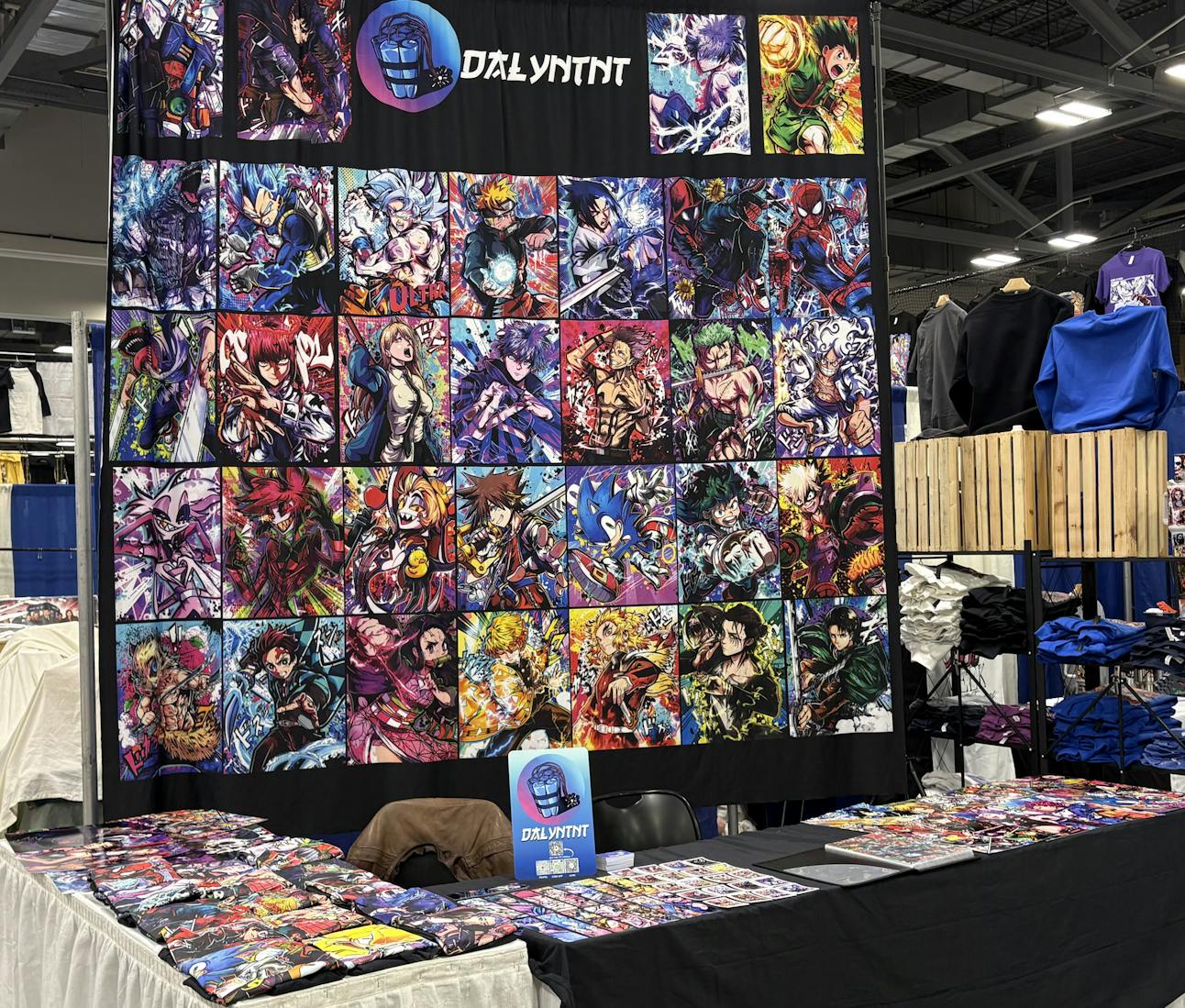
Dalyn keeps a recent message saved in his inbox. It appeared out of the blue one day while he was in the middle of drawing. It was from a student artist who gushed to him about his use of color, how the movement and feeling of his characters and style gave her joy in a way many artists can’t capture. “Your work stands out in such a powerful way and adds life to a space,” she told him. It brought him to tears. Him, inspiring someone? That was insane. An awesome kind of insane, but insane nonetheless. He didn’t think his work was good enough for that.
He dreams of his very own comic. The name is still stuck in the liquid stuff imagination is made of, but he sees clearly a man with white hair named Ronin, magic from a bolt of lightning, a murdered family, a missing sister, a cycle of violence, and two perspectives draped in shades of gray. It’s a mishmash of media that has deeply influenced him—“The Last of Us Part II,” “Demon Slayer,” “God of War”—but it’s also wholly his. It’s a ten-book long story. Maybe one day he’ll have the time, the energy, the money, and the confidence to create it. Maybe.

Then the piece is done, and Spider-Man stares up at him. Dalyn sits and stares back for a while. The stylus quivers a little in his grip. This is how he always feels when a work is ‘finished’: a deep-seated discomfort, an unhappiness he can’t quite shake. All he can see are the faults. He can’t see his artistic style comparing to those of the artists he loves. His contractors always say that it looks good, good enough to sell. They even put his works on their merchandise.
But it’s not good enough. It’s never good enough.
His phone buzzes on the desk, interrupting the music. Dalyn blinks, then picks it up, turning it on to see who messaged him. It’s his partner, Evelyn, who goes to a fancy university in Ohio, nearly four hundred miles away. Her grin in her contact photo takes his breath away every time.
You up?
He smiles and sets down his stylus, turning his chair away from his computer and the work that will perpetually feel unpolished and unfinished and unworthy, to hit the button to Facetime them. Maybe he can ignore the voice in his head for a little while.


