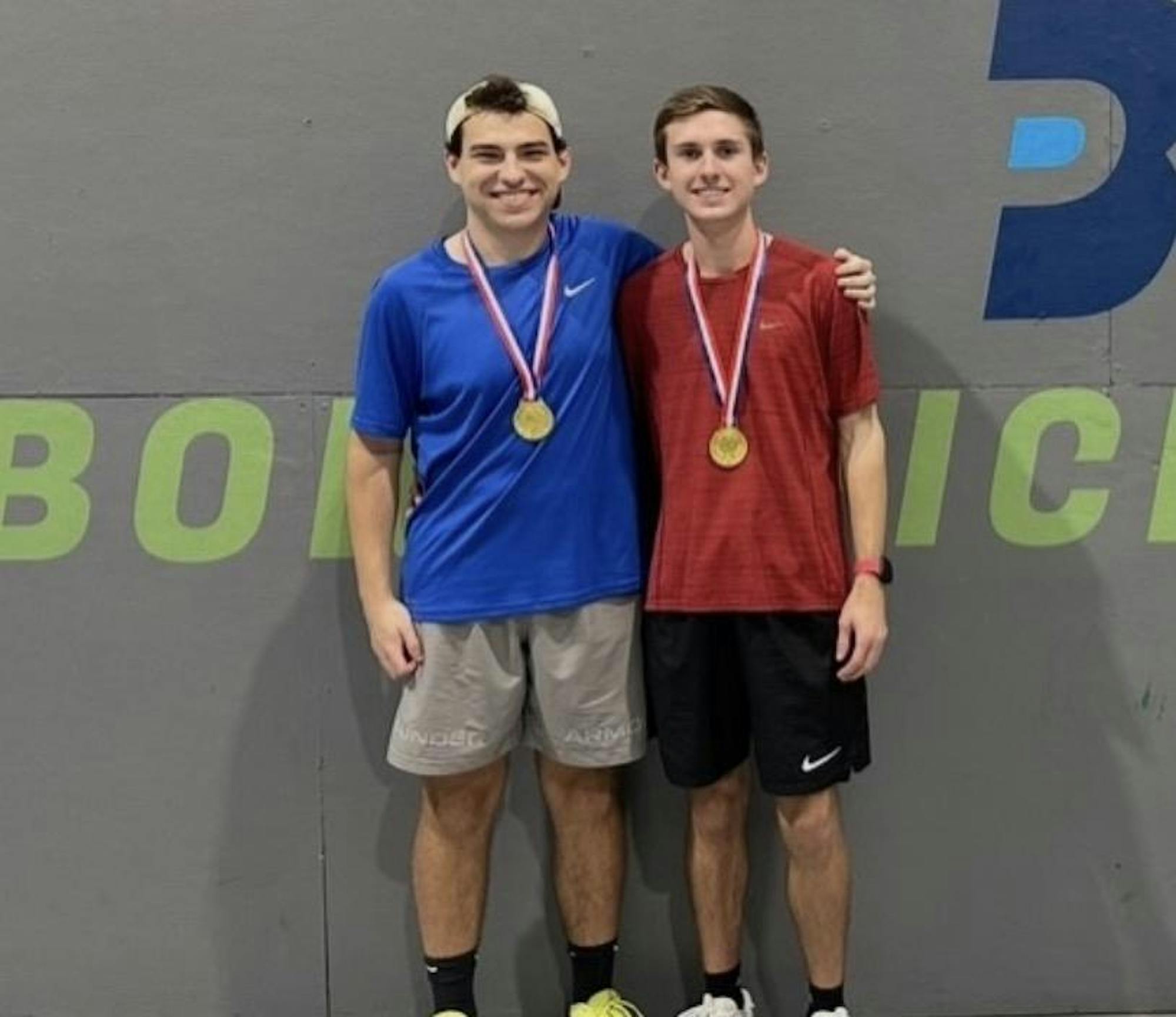
The gym hums long before the matches begin. Fluorescent lights buzz overhead, reflecting off polished hardwood courts where thin white lines carve out the geometry of competition. The sharp pop-pop of plastic balls meeting graphite paddles echoes like a metronome, steady and familiar. Along the sidelines, players stretch, chat, and compare equipment, their conversations blending into a low, constant murmur.
Pickleball, at first glance, doesn’t demand that kind of commitment. It looks approachable, even simple: a small court, a lightweight paddle, a perforated plastic ball. But Ryan Tenison is quick to dismantle that assumption. The game, he explains, is built on control and anticipation. Power helps, but patience wins more points. A single rally can stretch into a mental chess match, where placement matters more than force and hesitation is often the deciding factor.
Near the edge of the court, Tenison rests against the bleachers, paddle in hand but momentarily forgotten. A sophomore at the University of Tennessee, Knoxville, who’s studying Mechanical Engineering, occupies a space between two worlds, lecture halls during the week, tournament brackets on the weekends. His schedule is stitched together with road trips, early mornings, and the constant calculation of how to balance academics with a sport that refuses to stay casual.
His introduction to the sport wasn’t dramatic. No grand moment of discovery, no instant obsession. It began the way it does for many players—through curiosity, through a casual invitation to try something new. What lingered wasn’t just the gameplay, but the rhythm of it. The quick exchanges at the net, the strategy hidden beneath what looked like simplicity, the constant opportunity to improve. That was enough to keep him coming back.
Now, tournaments shape much of his life outside of school. Weekends are rarely spent resting. Instead, they’re filled with travel to different cities, each venue offering its own version of the same scene: rows of courts, the echo of paddles, players warming up with quiet intensity. Tenison talks about these trips with a kind of measured enthusiasm, not as glamorous adventures, but as necessary steps in something larger.
There’s a certain unpredictability to it all. Professional pickleball is still evolving, still figuring out its structure and scale. Prize money isn’t always consistent, and recognition can be uneven. Tenison acknowledges this without hesitation. There’s no illusion of guaranteed success, no promise that the effort will translate into something stable. But that uncertainty doesn’t seem to weigh on him as much as it might on others.
Yet the sport itself is undeniably on the rise. What once felt like a niche pastime has rapidly expanded into one of the fastest-growing activities in the country, drawing in players of all ages and backgrounds while gaining visibility through tournaments, sponsorships, and media coverage. Courts are being built in parks and gyms at a steady pace, and competitive opportunities continue to multiply. Tenison has watched that growth firsthand.
“A few years ago, you’d show up and recognize almost everyone,” he says. “Now every tournament feels bigger, deeper, more competitive.” For him, that expansion is part of the appeal. “It’s exciting to be in something while it’s still growing. You can feel the level rising, and it pushes you to keep getting better.”
Instead, he focuses on what can be controlled: preparation, mindset, and the gradual refinement of skill. He studies opponents when possible, paying attention to patterns and tendencies, but he’s equally focused on his own development. Small improvements matter, adjusting footwork, refining shot placement, learning when to be aggressive and when to hold back. Progress isn’t always visible in results, but it accumulates over time.
“I like that it’s a thinking game as much as a physical one,” he explains. “You’re constantly adjusting, trying to stay one step ahead.”
What stands out most isn’t just his dedication, but the way he talks about the community surrounding the sport. Pickleball has a reputation for bringing together unlikely groups of people, and Tenison leans into that idea. He describes tournaments where energetic teenagers compete alongside retirees who play for the enjoyment of the game, where seasoned players offer advice between matches, where competition and camaraderie exist side by side. It’s a rare environment in sports, one that feels less divided by age or background.
“You don’t get that everywhere,” he says. “Here, you can have a really competitive match and then be laughing with the same person five minutes later.”
That sense of connection seems to matter as much as the competition itself. Tenison doesn’t frame his experience purely in terms of winning or losing. There’s an appreciation for the process, the long days, the shared spaces, the conversations that happen off the court as much as the matches that happen on it.

“There’s a payoff beyond results,” he adds. “You build relationships, you learn discipline, and you see your own progress over time. That’s what keeps me invested.”
Balancing all of this with college life isn’t easy. Classes don’t pause for tournaments, and deadlines don’t shift to accommodate travel. Tenison speaks about it with a kind of practical acceptance. It requires planning, discipline, and sometimes sacrifice. Free time is limited. Social events are often missed. But there’s no sense of regret in the way he describes it, just an understanding that pursuing something seriously comes with trade-offs.
As the gym begins to quiet, the earlier energy fading into the background, Tenison gathers his things with an unhurried focus. The paddle is slipped into a bag, shoes changed, the rhythm of the space gradually winding down. There’s another tournament ahead, another set of matches waiting somewhere down the road.
For now, though, what remains is the impression of someone in motion, not just physically, moving from place to place, but mentally, always searching for the next improvement, the next challenge. In a sport still defining itself, Ryan Tenison seems content to grow alongside it, one tournament, one conversation, one carefully considered step at a time.