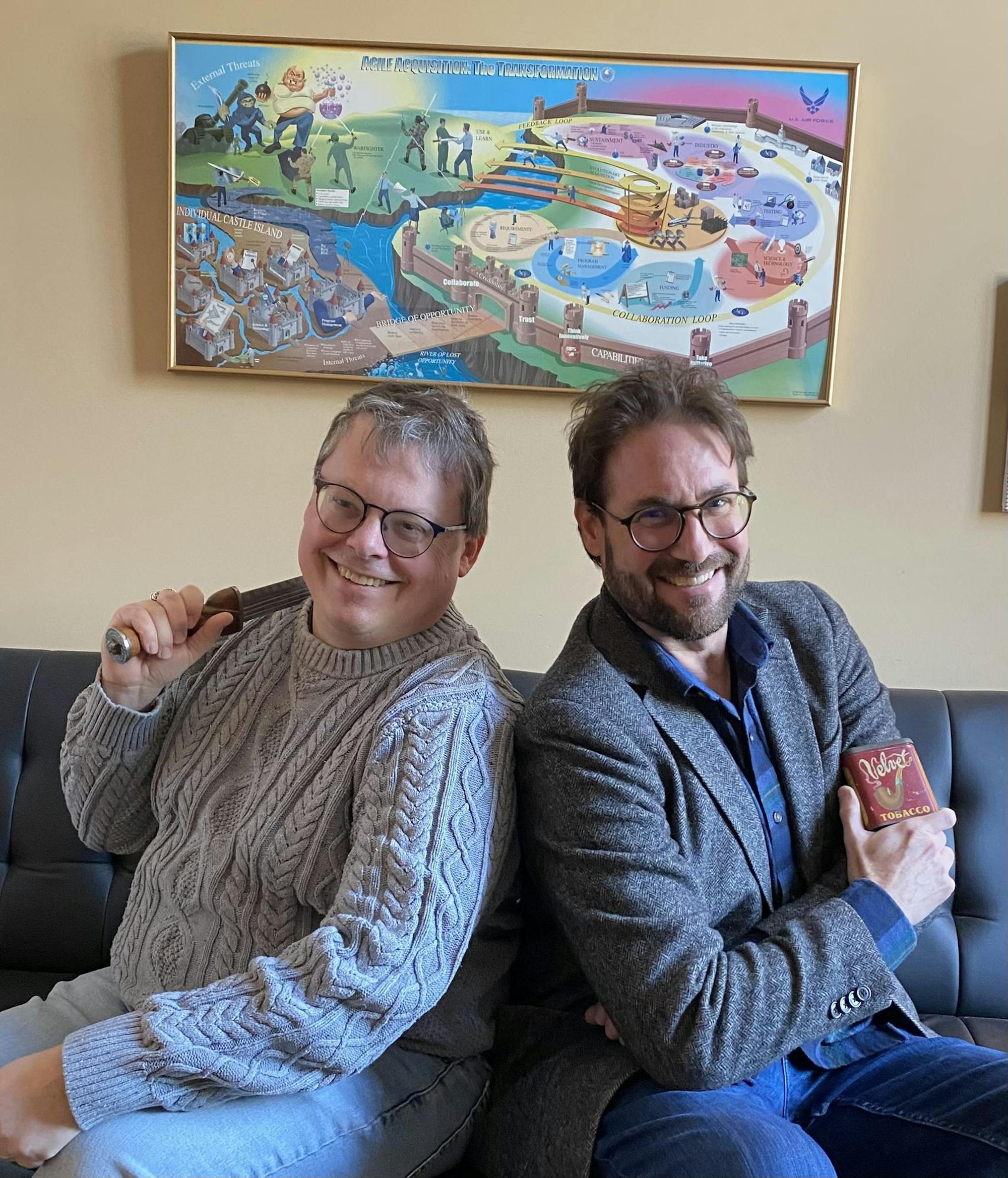
Cul-de-sac of the Mind:
Profs. Raffensperger and Jackson illustrate that starting with the same premise seldom results in deriving a similar conclusion.
Iconic TV Series "All in the Family"
Prof. Chris Raffensperger
Professor of History and Chair of the Department
Kenneth E. Wray Chair in the Humanities
Director, Ermarth Institute for the Public Humanities
Medieval Europe, Russia, Ukraine
The comedian Shane Gillis has a bit where his “Fox News Dad” asks “why are there Black people in all the commercials!?” In the roughly 70 years, his dad has been watching television, representation has changed immensely. Why? Well, kind of because of Archie Bunker.
Television used to be White. All White. All the time. Holiday classics like “Holiday Inn” had a Mamie character and did a President’s Day celebration in Black face and that was “okay.” It was not until the 1970s that this slowly began to change, in large part with “All in the Family.”
The show focused on Archie Bunker and his family and showed real debates, couched in humor, about Vietnam, Hippies, and race issues. Race was the major subplot (and often plot) in Archie’s relations with his neighbors the Jeffersons, a Black couple played by Sherman Helmsley and Isabel Sanford. “The Jeffersons” had their own spinoff, one of the very few Black-focused sitcoms.
Taking a different tack was another spinoff – “Good Times” which focused on a Black couple and their children living in the Cabrini-Green projects in Chicago. The excellent John Amos and Ether Rolle played the parents who were loving, but tough in realistic ways for the late 1970s. But it was the realism that was the draw, whether it was James threatening his son J.J. (Jimmie Walker) with a beating, or the crass racism of the police arresting J.J. (a 6+ foot tall string bean) because he fit the description of a robber who turned out to be 5’ 5” and fat, but also (consequentially) Black; all dealt with in the arc of the show and often with some humor to leaven the seriousness.
In the mid-1980s, the roster of shows featuring Black actors continued to grow. “227” featured not only Black actors, but specifically focused on Black women, and while the show was certainly a comedy, it also managed to deal with serious issues. Black comedians began to get their own shows as well, including “Martin” (Martin Lawrence) and “Bernie Mac.” Not to be left out, the Cosby Show (more infamous than famous now) was groundbreaking in its time, and its spinoff “A Different World” about life at a HBCU was even better. “A Different World,” following “Cosby” showcased different aspects of Black life. The students did not follow typical stereotypes of Black individuals. Jasmine Guy played a southern belle, and Kadeem Hardison was a math nerd, while their mentor was the strict Army colonel (Glynn Turman) with a secret soft spot for good kids. The cast and guest star list of “A Different World” is a who’s who of Black actors famous even today.
Norman Lear, who produced “All in the Family” and many of its spinoffs, was a key factor in the growth of Black representation on television. And while these shows are ancient history, it is important to know how the American experience has changed, just during the lifetimes of our parents, and grandparents.
Prof. Ross Jackson
Associate Professor of Business & Economics
Program Director, Master of Science in Analytics
Management
Success and relevance are infrequent companions in popular culture. The alignment of the two reflect a point at which a topic is socially important and timely. One occurrence of this is the “bunker verse,” named for the main character Archie Bunker, who appeared in Norman Lear’s TV show “All in the Family,” (9 seasons, from 1971-1979), and extended in the shows “Maude” (6 seasons, from 1972-1978), “Good Times” (6 seasons, 1974-1979), and “The Jeffersons” (11 seasons, from 1975-1985).
Along the spectrum from fantasy to realism, the bunker verse kept things real. In a broad stroke, “All in the Family” addressed cultural and generational conflict, “Maude” addressed feminism, “Good Times” addressed poverty, and “The Jeffersons” addressed race and social mobility. Each of these shows addressed these issues through the format of situational comedy (sitcom). Two elements essential to the sitcom format are: a) a recurring cast of characters, and b) a limited environment (or “container”). Within each of these shows, the recurring cast of characters was focused on family and neighbors, and the primary container was the home.
The 1970’s, like today, were a contentious time in the United States. There was Vietnam and Watergate, the Women’s liberation and Gay Pride movements, and economic insecurity and political unrest. Amongst it all, there was a pronounced generation gap between the youth (i.e., Baby boomers) and the older generation (i.e., WWII vets). It was a time in which those who valued the past felt they were losing control, and those who wanted progress felt constrained by an unresponsive system.
Through these tensions, American families in the 1970’s were able to sit around a common television set and watch shows that attempted to tackle these important issues with a degree of humor. One could laugh at the foolishness of “the other,” and maybe even laugh at the foolishness of oneself. For a moment there could be unity in entertainment if not agreement on position.
The America of today is still grappling with the same issues addressed in the bunker verse. There is both comfort and despair to be found in that. The persistence of these concerns suggests both that they are worthy of focus, and that progress will be uneven if not contested.
It is easier today than in any time in history to find like-minded individuals. Advances in technology have enabled connections that would have never happened two generations before. However, we now lack unifying experiences. Streaming entertainment viewed through a laptop means families seldom sit together to watch a common show. We used to see each other, literally in the family room, and metaphorically through the characters like those inhabiting the bunker verse. Norman Lear was able to show us our shared heart, dignity, and foolishness. Not “us” or “them,” but all of us together. In the words of the wistful lament of the opening theme to “All in the Family,” “those were the days.”