Cul-de-sac of the Mind:
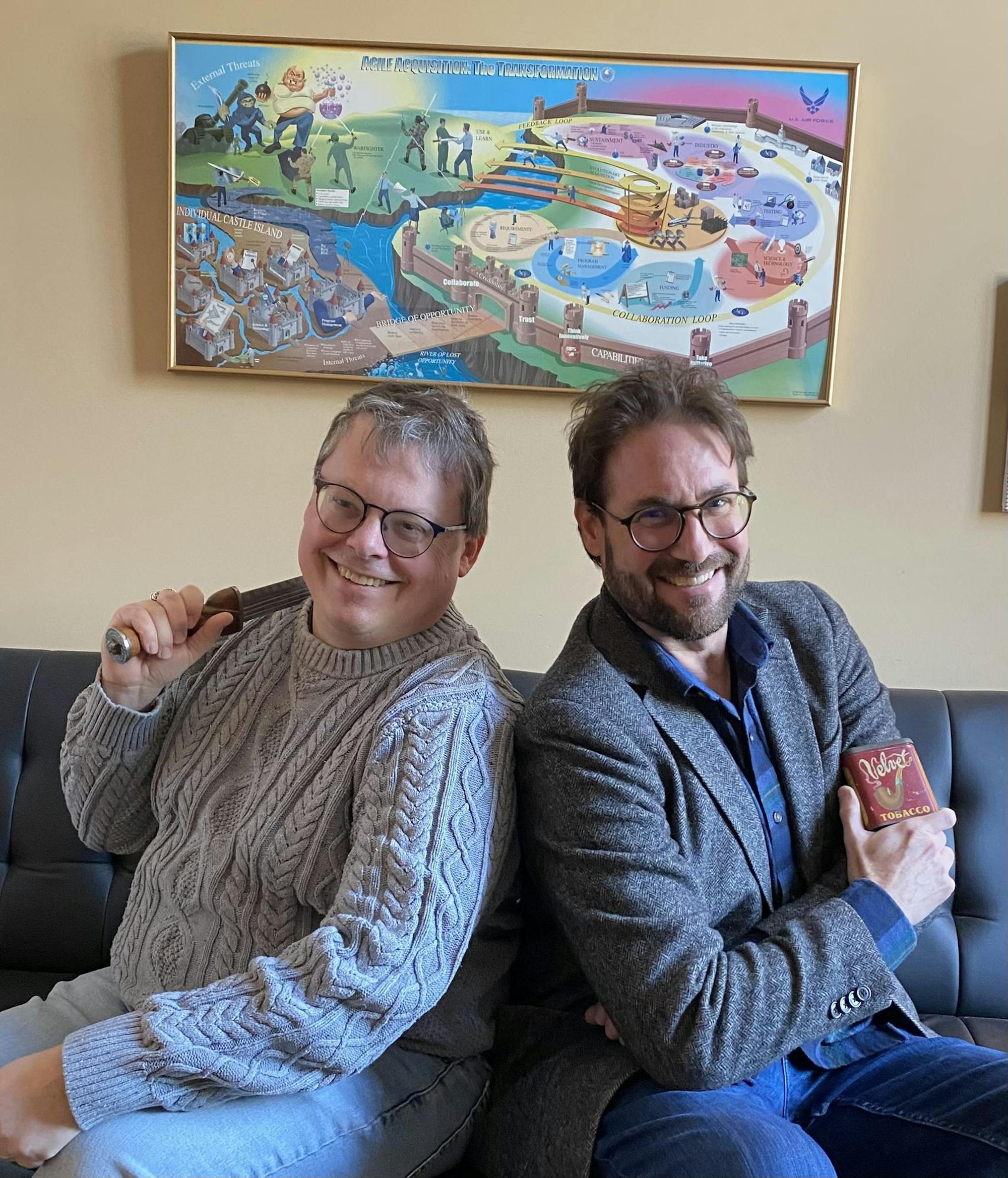
Profs. Raffensperger and Jackson illustrate that starting with the same premise seldom results in deriving a similar conclusion.
What are 5 books you would recommend to undergraduates and why?
Prof. Chris Raffensperger
Professor of History and Chair of the Department
Kenneth E. Wray Chair in the Humanities
Director, Ermarth Institute for the Public Humanities
Medieval Europe, Russia, Ukraine
When asked to recommend books to undergraduates, my first impulse is to decline. It’s not that I don’t think they will read them, I know they won’t read them. However, Dr. Jackson and I still need to write a column…
My initial recommendation would be to avoid "Oh, The Places You’ll Go!" This Dr. Seuss classic is a reliable gift for grads and has almost no utility. It doesn’t provide you with any life lessons you have not already learned, and because of its popularity, it isn’t worth much at the pawn shop or used bookstore.
On a sunnier note, I strongly recommend "The Old Man and the Sea." It’s a short book, with short sentences, which increases the chance that you might pick it up and, possibly, finish it. Without giving too many spoilers, Denzel Washington summed up the plot well in "The Equalizer" saying, “The old man’s gotta be the old man and the fish’s gotta be the fish.” That’s wisdom which you’ll understand after reading.
If you make it through "The Old Man and the Sea," it’s possible to read something a bit longer, for which I offer two options: "Pride and Prejudice" and "How to Read a Poem." Jane Austen is someone you’ve heard of, and the book deserves its “classic” label. It is an enjoyable read but also offers you the ability to point out that "Bridget Jones’ Diary" and "Fire Island" are based on this book, as well as helping you follow the plot of "Pride and Prejudice" and "Zombies." If you prefer poetry, or simply something shorter, "How to Read a Poem" succinctly teaches you to do just that through reference to wonderful poems. It’s also full of quotable quotes such as Samuel Becket’s description of time as: “that double-headed monster of damnation and salvation.” Quotes like that will come in handy when you have a paper due in an hour.
Having made it through two books, I want to offer something more serious, "It’s on You." The subtitle of this book explains it all, which is to say that it is about how corporations (informed by Business Professors) have tricked us all into believing that the world’s problems are our fault, rather than wider systemic issues that need to be addressed by the corporations themselves and world governments, not just putting blue bins in the classrooms. This is a powerful, fascinating, and depressing book – well worth your time now that you’re a reader.
However, reading all of this might affect your (probably already fragile) mental health. So, as a palate cleanser I recommend Terry Pratchett’s "Making Money." Pratchett’s work is silly fun, but incredibly well-written and filled with incisive insights into society. "Making Money," for instance, will lay out how belief in government is really what underlies currency, and why paper money is good, but also problematic.
Congratulations! If you have made it this far, you are a reader and perhaps will be on course to read not just these books, but even that copy of "Oh, The Places You’ll Go!" that you got for graduation.
Prof. Ross Jackson
Associate Professor of Business & Economics
Program Director, Master of Science in Analytics
Management
Reading forms a basis for learning, engagement, and entertainment. Just as “form follows function” in design, so too does book selection. My top five recommended books to undergraduate students were selected based on an assumption that a student is looking to engage in the world. For selection the books had to be less than obvious (students can find obvious books themselves), reflect well the context in which they were written, offer something relevant to the world of today, and be relatively brief. The books offered are listed in order of publication, list the title, author, and publication date. A quote from the book is provided as a teaser to its content, along with an assertion of its potential relevance.
"Imperialism, the Highest Stage of Capitalism," Valdimir Lenin (1917): “Peaceful alliances prepare the ground for wars, and in their turn grow out of wars; the one conditions the other, producing alternating forms of peaceful and non-peaceful struggle on one and the same basis of imperialist connections and relations within world economics and world politics” (p. 130). As long-standing, strategic alliances are being called into question and regional hegemony being (re)asserted, it is perhaps timely to examine linkages between monopoly capital and imperialism.
"On the Abolition of All Political Parties," Simone Weil (1943): “Only what is just can be legitimate. In no circumstances can crime and mendacity ever be legitimate” (p. 5). What is just requires no justification. Much is being done; educated citizens should question if it is legitimate.
"The Ethics of Ambiguity," Simone de Beauvoir (1948): “To be free is not to have the power to do anything you like; it is to be able to surpass the given toward an open future” (p. 91). The world likely does not come to us how we would like it. But we can each do what we can to improve it.
"The Society of the Spectacle," Guy Debord (1967): “The spectacle is the existing order’s uninterrupted discourse about itself, its laudatory monologue. It is the self-portrait of power in the epoch of its totalitarian management of the conditions of existence” (para. 24). The powerful require a captive and laudatory audience.
"An Essay on Liberation," Herbert Marcuse (1969): “The semi-democratic process works of necessity against radical change because it produces and sustains a popular majority whose opinion is generated by the dominant interests in the status quo” (p. 65). The homogenization of ideas is an important way those in power ensure its perpetual maintenance.
There is little utility in reading something that merely confirms what one already thinks. As Bob Dylan said, “You don’t need a weatherman to know which way the wind blows.” Likewise, you don’t need a book to tell you what you already know. The value derived through reading is that it can provide an opportunity to challenge one’s implicit assumptions, contribute to the crystallization of one’s thinking, and provide an ever-improving basis for action. Read, think, act!