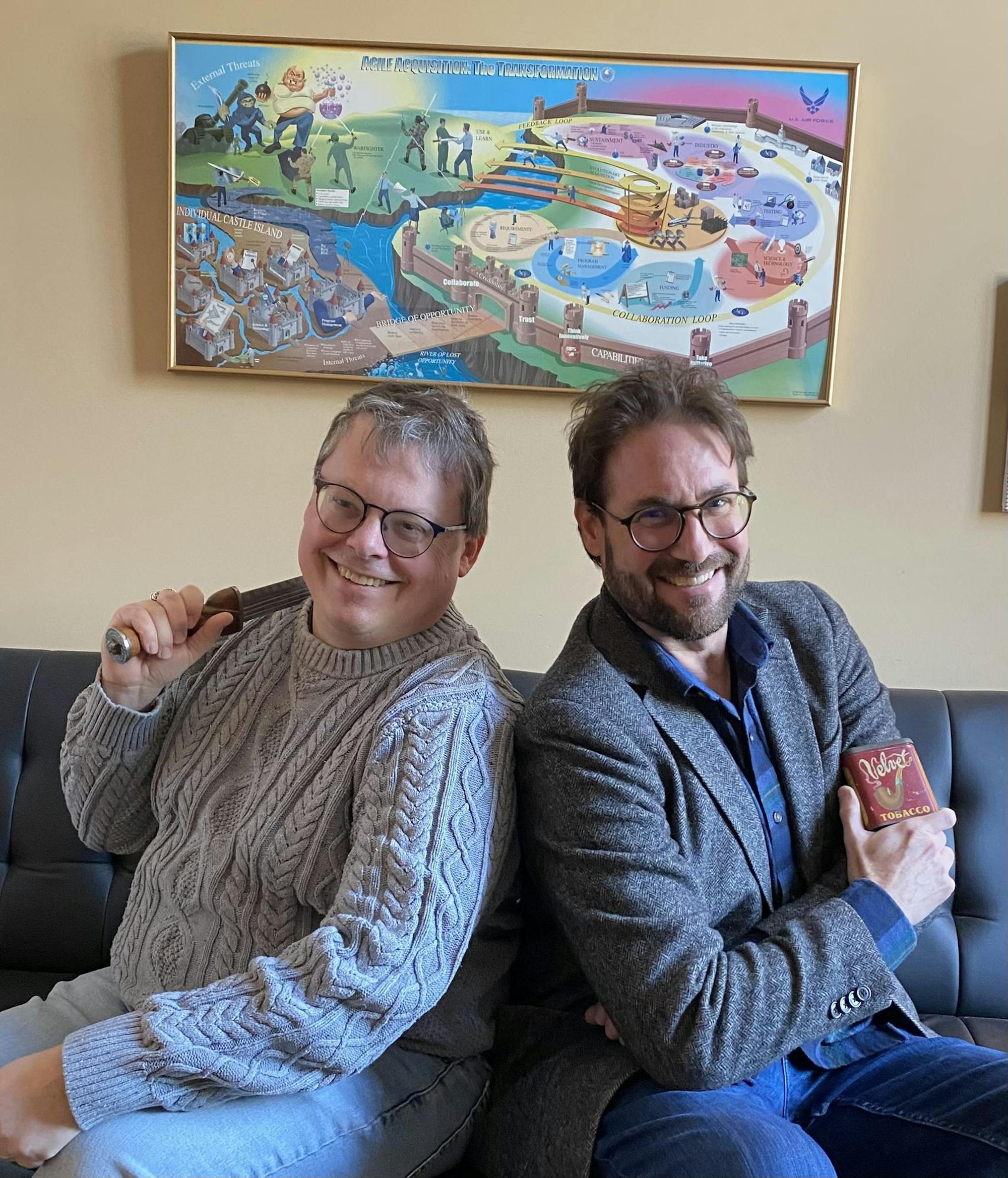
Prof. Chris Raffensberger
Professor of History and Chair of the Department
Kenneth E. Wray Chair in the Humanities
Director, Ermarth Institute for the Public Humanities,
Medieval Europe, Russia, Ukraine
As a cis-het individual who was born with a single X and a single Y chromosome, I am the last person who should be talking about virtue signaling, and yet here we are.
I live in a community that is largely white, and in fact was a creation of the man who created redlining (the process by which black families are kept out of white neighborhoods). Walking through the streets of the neighborhood, one can see signs indicating that “Hate has no home here” and “Black Lives Matter.” On the neighborhood Facebook group, it is not uncommon to have someone post a warning that a black man was spotted walking in the neighborhood. The disconnect between the two concepts should be clear.
Liberals are not the only ones who signal their virtue, of course. Heading into the local Schuler’s Bakery you will find a sign prominently displayed on the door saying that in this business they say “Merry Christmas; God Bless America; We salute our flag; Give thanks to our troops, police officers and fire fighters.” The sign concludes with a reinforcement of their virtue that “if this offends you, you are welcome to leave.”
Such instances of virtue signaling do not need to be as clearly coded liberal or conservative as those examples. After voting, there is a small pile of stickers indicating that “I OH voting”. While I worry about the syntax of the state of Ohio as a heart, the intent is clear. The subtext of wearing such a sticker is also clear. I did my civic duty and voted and I wear this sticker to proudly display that fact! Meeting another person with the sticker you can share a nod of greeting between virtuous equals, and seeing someone with no sticker can boost your sense of self-superiority. It is similar at blood drives where after donating and eating your donut (possibly from Schuler’s and thus offered with a “Merry Christmas”), you can take a sticker telling the world that “I gave blood.” Again, you are virtuous, and others who did not give blood are clearly not!
All of this talk of virtue signaling reminds me of a Seinfeld episode. Seinfeld is clearly a show that could not be made in the 2020s, and was already risqué at the end of the 1990s as its final episode showed the cast falling foul of “Good Samaritan” laws. In one episode, Jerry donates money and participates in an AIDS walk in New York. This was the time in which ribbons began to proliferate for all sorts of causes, diseases, and such. At the walk, Jerry is offered a red ribbon (the iconic ribbon for AIDS awareness) to wear and he declines. “He won’t wear the ribbon!” begins the call which runs throughout the episode. Jerry is repeatedly shamed for not wearing the ribbon, despite his protests that he has given money, is present, and is even helping to raise money for the AIDS walk. None of those things matters though, unless you “Wear the ribbon!” is the reply.
The takeaway from all of this should be that deeds matter more than words, but words are more visible than deeds. Do virtuous things, whether you signal them or not.
God Bless the United States of America!
Prof. Ross Jackson
Associate Professor of Business & Economics
Program Director, Master of Science in Analytics
Management
Since antiquity, human virtue has held a place of privilege, that has motivated individual action and garnered social recognition. Virtues like wisdom, courage, moderation, and justice (what are known as the four, cardinal Platonic virtues) have influenced much of the rhetoric, if not always the actions, within the West. In fact, to this day at least three of those virtues would likely be viewed positively. The virtue of moderation has largely been jettisoned for the pursuit of the illusive fulfillment promised by mass consumerism. Whereas debate certainly exists as to which virtues are in fact worthy of term, there doesn’t seem to be much debate that benefits derive from societies holding some sort of shared understanding of their collective virtues. However beneficial virtues are, virtue signaling is a different beast altogether.
As David Shariatmadari explained in his article ‘Virtue-signalling’ (sic) – the putdown that has passed its sell-by date, virtue signaling is “a form of vanity, all the worse because it’s dressed up as selfless conviction.” If virtues are focused on individuals doing “the right thing” (a concept one should always critique), virtue signaling is the result of the desire to be “seen” as holding the right position. At this point, it is reasonable to ask, what function does virtual signaling perform. In the article Virtue Signaling and Moral Progress, Evan Westra asserted that “One engages in virtue signaling in the hopes of seeing one’s moral reputation improve in the eyes of one’s peers (or potential customers); the desire to make a constructive, sincere contribution to public moral discourse is at best secondary.” It is this relative weighting that makes virtue signaling problematic. Within this frame, virtue signaling, as opposed to activism, is primarily about the individual not the issue. Stated differently, virtue signaling is a form of propaganda designed for self-promotion.
Wanting to be held in high esteem is nothing new. In reading biographies of accomplished individuals, one is often left with the feeling that a desire for the immortality which comes from respect was at least one of the motivating forces behind one’s accomplishment. The increase of social media has changed the economics associated with self-promotion and the curation of one’s image. Research by Sebastian Jungkunz found that “as political discourse increasingly moves online, the performative aspect of expressing moral indignation becomes even more prominent. Grandstanding not only serves as a means of self-enhancement but also deepens ideological divisions by reinforcing an ‘us vs. them’ dynamic.” In this light, virtue-signaling is not a consequence-free activity, as it simultaneously contributes to a distraction from a given issue of interest, as focus is directed to the individual rather than the cause, while simultaneously making the issue more difficult to resolve as people become further entrenched in their respective positions.
Social media, like all technologies, are not all bad. Technological advancements are generally referred to as improvements or progress for a reason. However beneficial these advancements might be, they seldom deliver fully on their promise, or produce benefit without cost. This is certainly the case for social media. There are at least two positive determinations one could make in confronting the phenomenon of virtue signaling. The first is to determine what are the virtues one holds personally. Part of the benefit of a liberal arts education in general, and pursuing the Wittenberg Way in particular, is that one is afforded the opportunity to examine, critique, and reflect on various sets of virtues. Second, one could question what forms of engagement one would be willing to enact even if there was no social recognition derived in the process.
There is nothing wrong with being recognized for one’s contributions. Societies function, in part, by recognizing the virtuous. Virtue signaling attempts to short-circuit this process and enable individuals to produce the desire recognition without accomplishing anything of real and lasting value. Such illusions are as transitory as they are meaningless, and trap individuals in a cycle of performative actions of limited effect. There is little virtue in that.